
Last updated October 17, 2026
 Metal roofing
 Architectural shingles
 Tile roofing
 GAF
GAF Owens Corning
 Flat & low-slope
Free roof inspection with deck photos before we talk money - GAF and Owens Corning certified installation
Roofing Company Maintenance Checklist for Riverside Homeowners
Ask a roofing contractor in Riverside what actually kills roofs here, and you won’t hear much about storms. You’ll hear about the quiet stuff. Cracked pipe boot flashings. Dried-out caulk joints at parapet walls. Tile that shifted one heat wave at a time until the underlayment sat exposed. The most common source of premature roof failure in Riverside isn’t storm damage. It’s cracked pipe boot flashings and dried-out caulk joints that go unnoticed for two or three years because homeowners didn’t know they were inspection items. This guide walks you through what to check, when to check it, and what belongs in the hands of a pro-like our Roofing Company services.
Styles & brands we work with
Quick Answer
A proper Riverside roof maintenance checklist covers three zones: ground-level and gutter checks you can do safely yourself, attic inspections for early water-intrusion signals, and on-roof items that require a trained contractor. In Riverside’s heat, the critical inspection items are pipe boot flashings, exposed caulk joints, flat-roof membrane seams, and tile that has shifted out of position. Run the ground and attic checks twice a year, and have a professional roof inspection once a year.
Table of Contents
- Why Riverside’s Climate Demands a Different Checklist
- Safety First: What a Homeowner Should Never Do
- Ground-Level and Gutter Checks You Can Do Yourself
- Attic Checks: Catch Roof Problems Before They Show Outside
- What Requires a Contractor on the Roof
- Riverside’s Seasonal Inspection Schedule
- Documenting Your Roof: Annual Photo Baselines
- Common Mistakes to Avoid
- When to Call a Professional
- Frequently Asked Questions
- The Bottom Line
Why Riverside’s Climate Demands a Different Checklist
Riverside sits in a hot-summer Mediterranean climate zone, which sounds pleasant until you translate it into what your roof endures. We routinely see summer daytime highs above 95 degrees, with roof surface temperatures running 40 to 60 degrees hotter than the air. A dark asphalt shingle roof in Riverside can hit 150 degrees on a July afternoon. That heat doesn’t just sit on the surface. It expands materials, cooks adhesives, and accelerates the breakdown of any rubber or plastic component on the roof.
Then comes the part most people don’t expect. When it does rain in Riverside, the rain often arrives after a long dry spell and carries a slightly acidic load from accumulated atmospheric dust and vehicle emissions. That acidic water sits in valleys, runs down flashing seams, and finds its way into any crack the heat has already opened. The cycle is simple: heat creates the opening, a rare rain event exploits it, and three months later a homeowner notices a ceiling stain and calls us wondering what happened.
Add to that the Santa Ana winds, which arrive in fall and early winter. Those winds carry fine desert grit that works its way under tile edges and into flashing laps. Over years, that grit acts like sandpaper every time the wind blows. A roof that looks fine from the street can have thousands of tiny abrasion points hiding under the surface.
None of this shows up on a generic spring-and-fall checklist written for a homeowner in Ohio. Riverside demands its own schedule and its own set of inspection priorities. That’s exactly what this guide provides, and you can find more guides & resources on our blog.
Safety First: What a Homeowner Should Never Do
Before we get into the checklist, we need to draw a hard line. Roof work is dangerous, full stop. In our experience at Brennan Roofing Co Riverside, the injuries we hear about most often come from homeowners who went up “just to take a quick look.” A steep pitch, a loose tile, a patch of morning dew on shingles, and the situation changes in half a second.
Here is the boundary we recommend, and we hold to it on every job we run:
- Safe from the ground: visual checks of the roof edge, gutters, downspouts, flashing at chimneys and vents that you can see clearly without leaving the ground.
- Safe from a ladder, with caution: gutter cleaning and debris removal, provided the ladder is on level ground, someone is holding it, and you never step onto the roof itself. If you are not comfortable on a ladder, don’t push it. Gutters aren’t worth a fall.
- Never safe for a homeowner: walking the roof surface, inspecting tile or shingle condition up close, checking flashing and pipe boot seals, cleaning valleys, or working on any roof with a pitch steeper than 4:12. That’s contractor territory. A professional roofer in Riverside carries the right safety equipment, insurance, and training for that work.
If you have any doubt about whether a check belongs on your list or ours, call us at (341) 208-3988. We’ll tell you straight. No charge for the conversation.
Ground-Level and Gutter Checks You Can Do Yourself
You can catch roughly a third of the roof problems we see in Riverside without ever leaving the ground. These checks take about twenty minutes, and they’re worth doing every quarter. Here’s what to look for, walk around the house with a pair of binoculars if you have them.
1. Gutter Debris and Granule Build-Up
Asphalt shingles shed granules over their lifespan. Finding a light dusting of granules in your gutters is normal, especially on a roof that’s been through a few Riverside summers. Finding a thick layer of granules, or noticing that the granules look like they’re accumulating in dark streaks at the gutter line, is a different story. That signals the shingles are losing their protective surface faster than they should. On a tile roof, look for cracked tile pieces and debris that could be hiding a slipped tile.
What to do: clean gutters twice a year, minimum. In Riverside, the best times are late October after the first Santa Ana winds and late April as the rainy season ends. If you see heavy granule loss, call us for a closer look.
2. The Roof Edge and Fascia Line
Stand back far enough to see the whole roofline. Look for:
- Tiles or shingles that sit slightly out of alignment compared to the rest of the row.
- Any dark staining along the fascia board, which often means water is running behind the gutter instead of into it.
- Visible gaps at the drip edge, the metal strip that runs along the roof’s edge and directs water into the gutter. If the drip edge pulls away, water can wick back under the roof’s edge and into the decking.
3. Pipe Boots Around Plumbing Vents
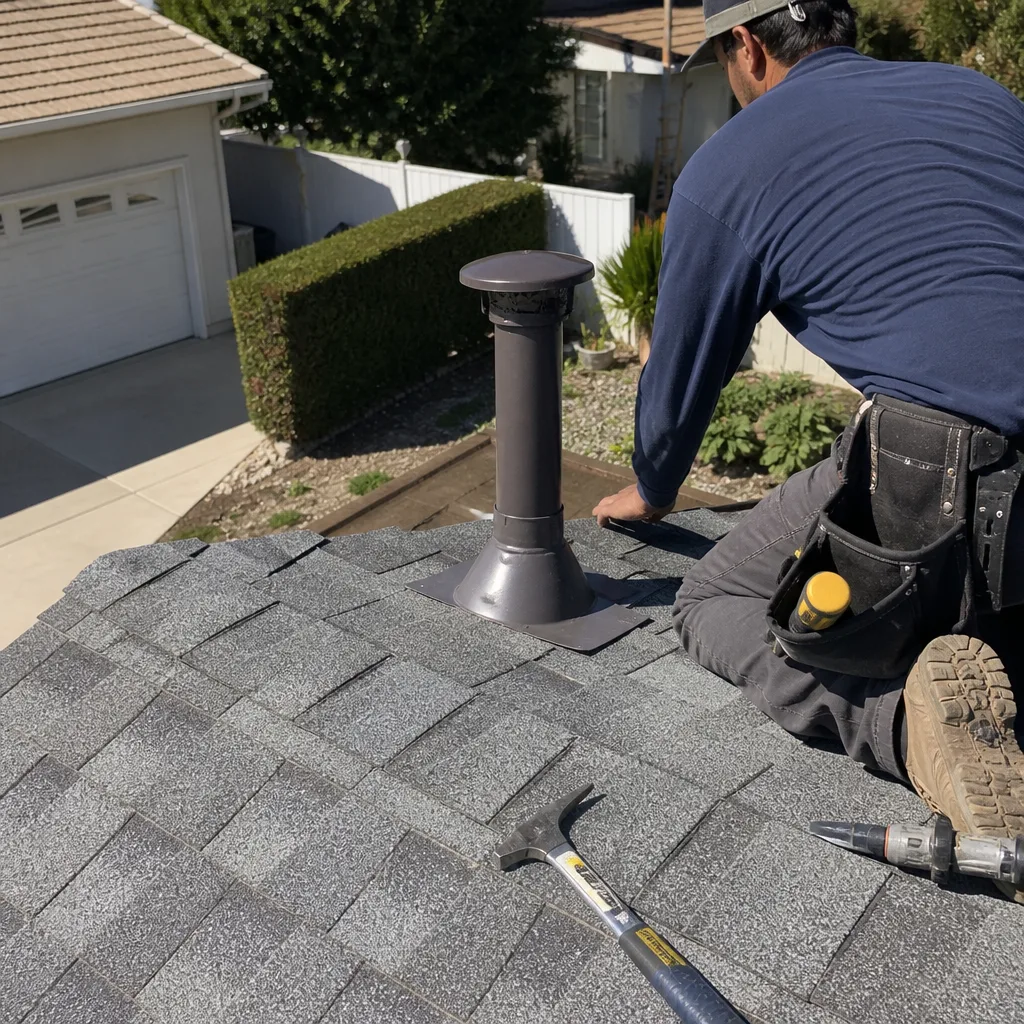
If your roof has plumbing vent pipes visible from the ground, look at the rubber boot that surrounds each pipe where it comes through the roof. In Riverside, these boots crack from heat and UV exposure. A cracked pipe boot is the single most common source of small roof leaks we repair in older Riverside homes. From the ground you may not see a crack, but you can often see the boot pulling away from the pipe or sitting at an angle. If the boot looks brittle, discolored, or has visible splits, it’s time for a replacement.
4. Chimney and Skylight Flashing
Look for visible rust, separation, or missing sections of the metal flashing around chimneys, skylights, and any roof penetrations. Flashing is the sheet metal that seals the seam where the roof meets a vertical surface. In Riverside, valley flashing sometimes corrodes from infrequent but acidic rain events. From the ground, look for dark streaks below the chimney or skylight line, pulling-away metal, or gaps you can see with the naked eye.
Attic Checks: Catch Roof Problems Before They Show Outside
The attic is the best early-warning system your roof has. Long before water stains appear on a ceiling, the attic shows subtle signs. A twenty-minute attic inspection twice a year catches problems while they’re still cheap to fix. Here’s what to look for:
1. Staining Patterns on the Underside of the Decking
The decking is the plywood or OSB layer the roof covering attaches to. From inside the attic, you’re looking at its underside. Dark stains usually mean water has gotten in and sat for a while. But pay attention to the shape. A round stain near a pipe usually indicates a pipe boot failure. A long, straight stain that runs along a seam often points to a valley flashing or deck seam issue. A stain that widens near the ridge suggests a ridge vent problem.
2. Insulation Compression
Water that reaches the attic floor soaks into the insulation and compresses it. Walk the attic carefully (on the joists, never between them) and feel for sections of insulation that are flattened, crusty, or matted down compared to the surrounding areas. Compressed insulation loses its R-value, which means your cooling costs go up even if the leak itself is small.
3. Ridge Vent Blockage
Most Riverside homes have either ridge vents, turbine vents, or box vents. A ridge vent runs along the peak of the roof and lets hot air escape. From inside, make sure the ridge vent isn’t blocked by debris, insulation, or nesting material. A blocked ridge vent traps heat in the attic, which raises the roof deck temperature, which accelerates shingle aging. If your attic is noticeably hot even on a mild day, there’s a ventilation problem that needs addressing.
4. Light Coming Through Where It Shouldn’t
On a bright day, turn off the attic light and let your eyes adjust. Pinpoints of daylight coming through the roof deck mean gaps in the roof structure. Light through the ridge line means a ridge vent issue. Light around pipes or vents means flashing failures. Any daylight penetration is a water penetration waiting to happen.
What Requires a Contractor on the Roof
Some inspection items cannot be done from the ground or the attic. They require boots on the roof surface, and for good reason. These are the items we cover in every roof inspection in Riverside we perform. Here’s what’s happening up there, and what we’re looking for:
1. Flat Roof Membrane Checks
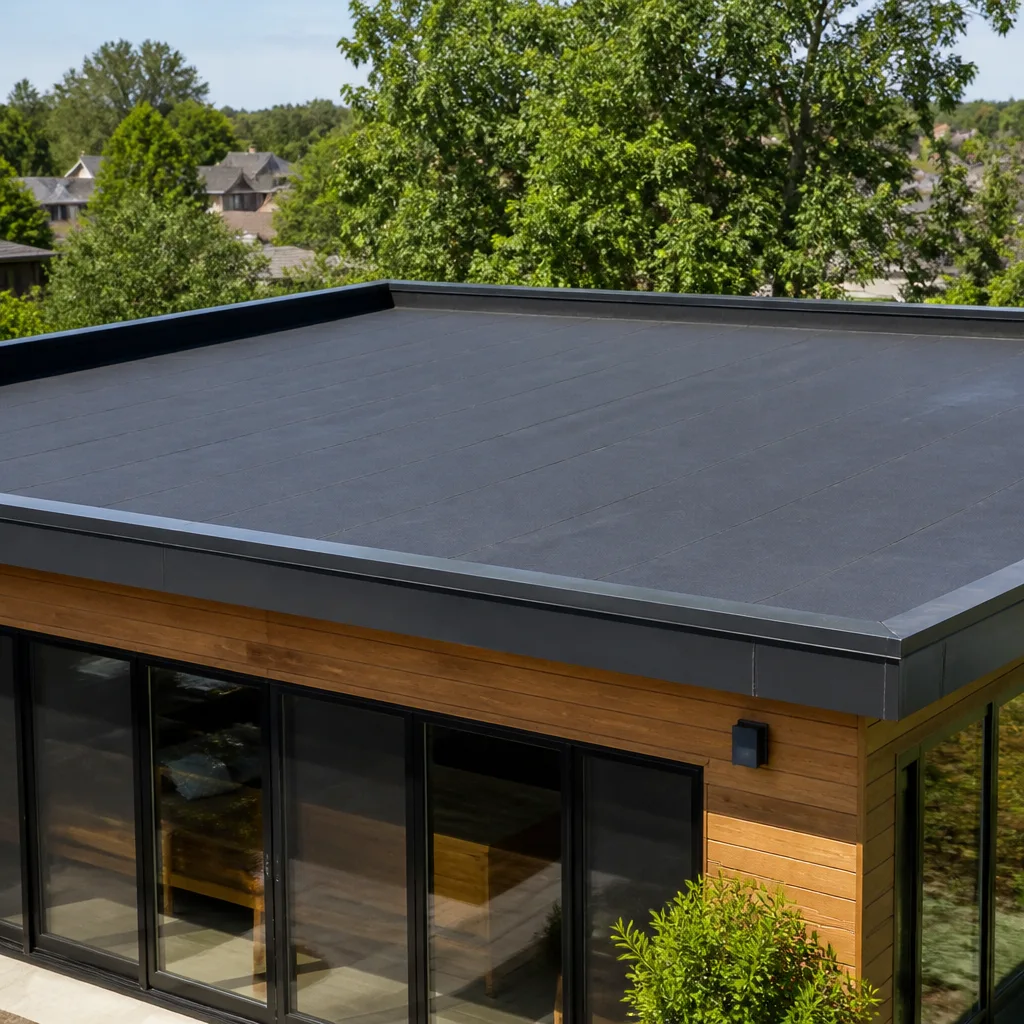
Riverside has a significant stock of homes with flat or low-slope roof sections, particularly in older mid-century neighborhoods and commercial-residential mixed areas. Flat roofs here fail differently than sloped roofs. The heat causes thermal expansion in the membrane, which can pull seams apart over time. We look for blisters, cracks at the seams, and areas where the membrane has separated from the decking below. A flat roof membrane can look fine from a distance and be within months of failing up close.
2. Tile Slippage from Heat Cycles
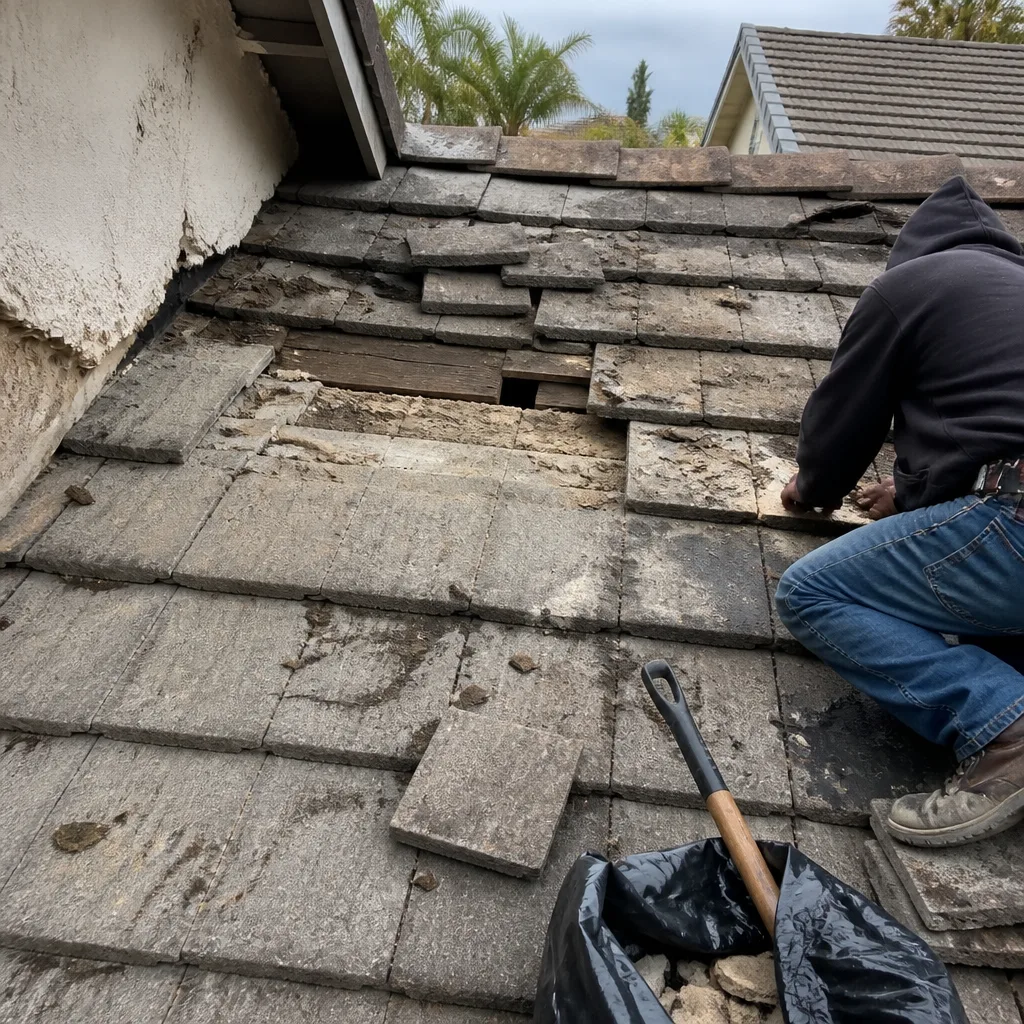
Riverside’s heat cycles put unusual stress on tile roofs. Concrete and clay tiles expand and contract with every hot day and cool night. Over thousands of cycles, the fasteners that hold tiles in place can loosen. A slipped tile exposes the underlayment beneath, and once the underlayment is exposed to UV and heat, it degrades quickly. We walk tile roofs carefully (never stepping on the edges of tiles) and check for slipped, cracked, or loose tiles. This isn’t a ground-level check. A tile that looks fine from below can be hanging by a single fastener.
3. Pipe Boot and Caulk Joint Evaluation Up Close
From the roof surface, we can feel the rubber boot. If it flexes and returns to shape, it’s still serviceable. If it feels stiff or crumbly, or if we can see hairline cracks from inches away, it gets replaced. The same goes for caulk joints at parapet walls, chimney bases, and any vertical transition. Caulk in Riverside dries out faster than almost anywhere else in the state. We inspect every joint and re-seal any that show signs of dryness.
4. Flashing and Valley Corrosion
Riverside’s acidic rain events are infrequent, which is exactly why they cause damage. When acidic water sits in a valley flashing for even a few hours, it starts a corrosion process that goes unnoticed through months of dry weather. By the time you see rust from the ground, the flashing is compromised. From the roof, we can see the early-stage corrosion and address it before it becomes a leak.
Riverside’s Seasonal Inspection Schedule
Most maintenance guides say “inspect in spring and fall.” For Riverside, that schedule works, but for different reasons than it does elsewhere. Here’s the schedule we recommend, mapped to what actually happens in the Inland Empire:
- Late April to early May: after the last meaningful rain, do your ground-level and attic checks. The rainy season is over. Any water that got in during winter is now visible as staining or insulation compression. This is also the best time to schedule a professional roof inspection, because the contractor can see everything without wet-weather interference.
- Late October to early November: before the first winter rain and after the first Santa Ana winds, clean gutters and repeat the ground-level checks. Look for wind-blown debris, loose tiles at edges, and any flashing that’s been bent or lifted by wind. Get on the calendar for any repairs before the rain arrives.
- After any wind event over 40 mph: walk the perimeter and look for shingles or tiles on the ground, new gaps at the roofline, or debris in the gutters. Wind damage often shows up as subtle edge lifting rather than obviously missing material.
- Anytime you notice a new ceiling stain, musty smell, or unexplained spike in cooling costs: don’t wait for the seasonal check. Call us. The seasonal schedule is for maintenance. An active issue is a different category.
Riverside homeowners who run this schedule catch most roof problems while they’re still repair-sized. The ones who wait until a ceiling stain appears are usually looking at a larger job.
Documenting Your Roof: Annual Photo Baselines
Here’s a practice that saves Riverside homeowners real money, and almost nobody does it. Once a year, take a full set of roof photos from the ground. Use a phone camera or a DSLR, whatever you have. Here’s the system:
- Stand at each corner of the house and shoot the entire roofline from a consistent distance.
- Shoot each chimney, skylight, and visible vent pipe up close, zooming in enough to see the flashing and boot condition.
- Shoot each valley where two roof planes meet.
- Shoot the gutter line around the full perimeter.
- Label the photos by date and save them in a folder.
Why this matters: when a contractor tells you a tile is broken, a flashing is failing, or a leak is from “normal wear and tear,” you have a dated baseline to compare. You can see whether that damage was present last year and you missed it, or whether it’s new. This is also helpful for insurance claims. An adjuster looking at a photo sequence that shows a roof in good condition three months before a wind event is looking at a much stronger claim than one based on “the homeowner says it was fine.”
We recommend running this photo documentation at the same time as your late-April inspection, when the light is good and the roof is dry. It takes fifteen minutes a year.
Common Mistakes to Avoid
- Ignoring the pipe boots until there’s a leak. Pipe boot flashings are the most common failure point we see on Riverside roofs. They cost a small amount to replace before they leak and a lot more after.
- Cleaning gutters without checking the roof edge. A gutter full of granules tells you something about the shingles above it. If you clean the gutter and ignore the signal, you miss the point.
- Assuming tile roofs don’t need maintenance. Tile itself lasts a long time, but the underlayment beneath it does not. Slipped tiles expose underlayment, and once it degrades, the repair gets bigger.
- Painting over a ceiling stain instead of finding the source. A stain is a symptom. Paint covers it for a while. The roof leak doesn’t care.
- Using a generic checklist that doesn’t account for Riverside’s heat. A homeowner who follows a Midwest spring-and-fall checklist misses the thermal expansion issues that actually drive Riverside roof failures.
- Letting a roofer on the roof without a written inspection report. Any legitimate inspection should produce a written record of what was found, with photos. If a contractor won’t put it in writing, the inspection didn’t happen in any useful sense.
- Deferring small repairs because it hasn’t rained yet. Riverside’s long dry season is exactly when small roof problems should be fixed. The roof is dry, the materials are workable, and you’re not racing a storm. Waiting until the day before rain is how small jobs turn into emergency calls.
When to Call a Professional
Some situations don’t belong on a DIY checklist at all. If you see active water intrusion in the attic, call a roofer that day. If you notice a visible sag in the roofline, that’s structural and needs immediate attention. If you find light penetration around pipes, vents, or the ridge line, get it assessed. If your roof is more than fifteen years old and hasn’t had a professional inspection in three years or more, schedule one. In Riverside, the heat ages roofs faster than the calendar suggests. A fifteen-year-old roof here can look like a twenty-year-old roof elsewhere. Roof repair in Riverside is almost always cheaper when it’s proactive rather than reactive. Brennan Roofing Co Riverside offers free estimates in Riverside. Call (341) 208-3988 to schedule one.
Frequently Asked Questions
Most roof inspections in Riverside run between $150 and $400, depending on roof size, complexity, and whether the inspection includes drone imaging or attic access. For a detailed look at what drives these numbers, see our Roofing Cost Breakdown: The Riverside Homeowner’s Reference for 2026. Some contractors offer free inspections as part of an estimate for a known repair. At Brennan Roofing Co Riverside, we provide written inspection reports with photos as part of our standard estimates. Call (341) 208-3988 for current pricing.
Once a year is right for most Riverside homes, ideally in late April or early May after the last winter rain. Homes with flat roof sections, older tile underlayment, or a history of leaks may benefit from twice-yearly inspections. Riverside’s heat accelerates material aging, so annual inspections catch problems before they become leaks.
Cracked pipe boot flashings are the most common roof problem we see in Riverside. The rubber boots that seal plumbing vent pipes crack from heat and UV exposure, often within five to eight years of installation. They leak slowly at first, so the damage accumulates before a homeowner notices any visible water inside the house.
No. Walking on a tile roof is dangerous and often damages the tiles. Concrete and clay tiles crack easily under foot traffic, especially at the edges and corners. A homeowner walking a tile roof can cause more damage in ten minutes than the inspection was meant to find. Leave on-roof inspections to a trained contractor with the right safety equipment.
Asphalt shingle roofs in Riverside typically last 15 to 20 years, as opposed to 25 to 30 in milder climates. Tile roofs can last 50 years or more, but the underlayment beneath the tile usually needs replacement every 15 to 25 years depending on the original material quality. Flat roof membranes in Riverside often need major service between 10 and 15 years due to thermal expansion stress.
Yes. Every inspection we do at Brennan Roofing Co Riverside home produces a written report with photographs of any problem areas, a plain-English explanation of what we found, and a written price for any recommended repairs before any work begins. No work starts until you have the price on paper. That’s how we’ve operated since we opened in Riverside in 2000, and it doesn’t change.
The Bottom Line
A Riverside roof fails differently than a roof in Seattle or Chicago. Here, the damage is slow, heat-driven, and easy to miss if you’re not looking for it. The checklist that matters is simple: check pipe boots, caulk joints, flashing, and tile alignment. Check the attic for stains, compression, and daylight. Document your roof annually. And once a year, get a professional on the roof who knows what Riverside’s climate does to roofing materials-and understands Roofing Permits, Codes & Inspections in CA: What You Need to Know. Catch problems early, and roof maintenance is measured in hundreds of dollars. Wait for the leak, and it’s measured in thousands. The math runs one direction.
Need a professional inspection in Riverside? Call Brennan Roofing Co Riverside at (341) 208-3988. We’ll put a written price in your hand before any work starts, and every job carries our 365-Day Done Right Promise in writing for one full year.
Written by Travis Oakley, Owner at Brennan Roofing Co Riverside, serving Riverside since 2000.
See the difference
 Before
 After
After Before
 After
After Before
 After
After